
By Benedict Mukoni and Immaculate Tusingwire, MMS
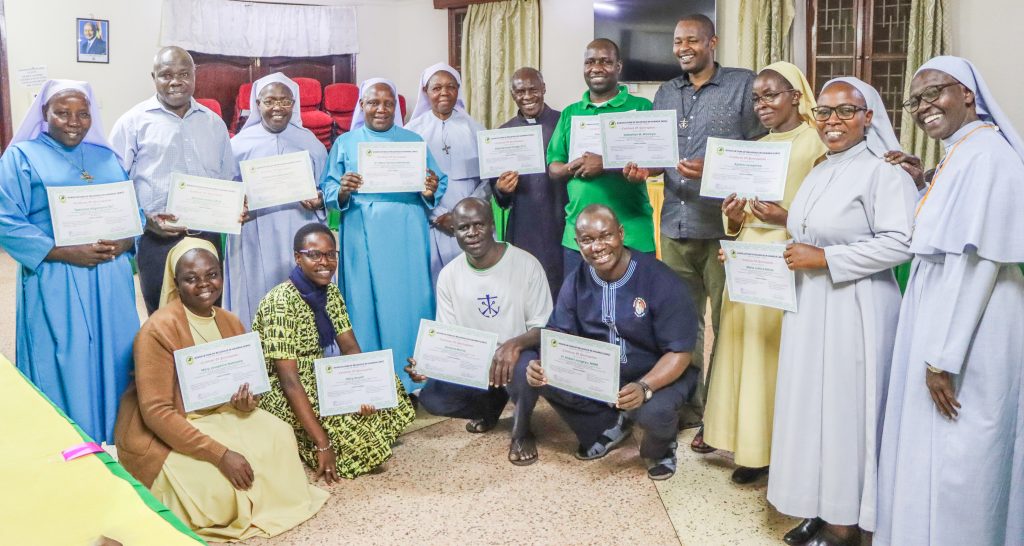
The Association of Religious in Uganda (ARU), commissioned Chapter Facilitators on 13 December 2025 at the ARU Secretariat after completing eight weeks of General Chapter Facilitation Training.
The commissioning marked an important milestone in strengthening chapter processes within religious congregations.
The trained facilitators were both priests and religious sisters from different congregations coming from Uganda and Kenya.
According to one of their facilitators, Sr. Margaret Uraa, MSMMC, the newly trained facilitators are well prepared
and equipped with the necessary knowledge and skills. Through practical sessions and simulations, theyhave learned how to guide chapterseffectively. Even though Sr. Margaret recommended co-facilitation with experienced facilitators at the beginning, she asserted that they are fully capable of facilitating chapters independently when given the opportunity. Thus,
calling upon superior generals to give them opportunities to serve in chapters across different institutes.
Currently, ARU has about 30 trained chapter facilitators. While this is a significant achievement, Sr. Margaret also noted that there is a growing need for empowerment and wider recognition of the role of Chapter facilitation. She urges the Superior Generals to understand the importance of chapter facilitation by allowing more members to be trained.
Every congregation is required to hold a chapter, usually after five or six years. Since these chapters play a crucial role in guiding the life, governance, and future direction of religious institutes, they need good facilitation, Sr. Margaret noted. Chapter facilitators serve
as consultants within their own Institutes, guiding Chapter Planning Committees in preparing members well
ahead of the chapter. This preparationhas significantly improved chapter celebrations, reduced conflicts, and promoted unity.
The way chapters are conducted today is markedly different from the past. Previously, chapters largely followed a parliamentary method, which often led to tension and conflict. Today, the process is guided by the Spirit, fostering deeper reflection, dialogue, and
unity. This shift has brought positive transformation to the life of many institutes, making chapter celebrations more meaningful and effective.
Of the 3 trainers were also Sr. Florence Kajoina, DST and Sr. Pauline Namuddu LSOSF.
Besides training others, they are willing to co-facilitate chapters with the junior facilitators since they believe that mentorship approach ensures skills are practiced, strengthened, and passed on. Training without practice risks losing valuable knowledge and potential.
They noted that allowing junior facilitators to learn through practice will ensure continuity and sustainability of quality chapter facilitation.
Chapter facilitators are not only valuable when it comes to chapter facilitation, they can also help facilitate other important meetings
of the institutes to ensure smooth processes and make desired decisions.
The trainers also noted that in the past, chapters were often facilitated solely by canonists, but now they see that chapter facilitation
goes beyond legal knowledge, even though it remains important.
It involves leading members back to the roots of their foundation, the charism, and the spirit of the founder. This holistic approach is
what makes trained chapter facilitation transformative.
ARU remains committed to strengthening chapter facilitation for the good of religious institutes, ensuring that chapters continue to
be moments of deep discernment, renewal, and faithful service to the mission of the Church.
