By Immaculate Tusingwire, MMS
A priest is always associated with the altar, prayer, and the care of souls. In our feature story today, we bring you Fr. Henry Kajubi who has defied this association and lives at a dynamic intersection of faith and science as a Holy Cross priest and a PhD candidate in Nuclear Physics. In an interview with the Association of Religious in Uganda’s Prophetic Witness, he shares his remarkable journey to both Priesthood and the world of science, reflecting on the relationship between faith and physics, and the Christian responsibility of caring for creation.
If someone asked you who Henry Kajubi Ssenteza is, what would you say?
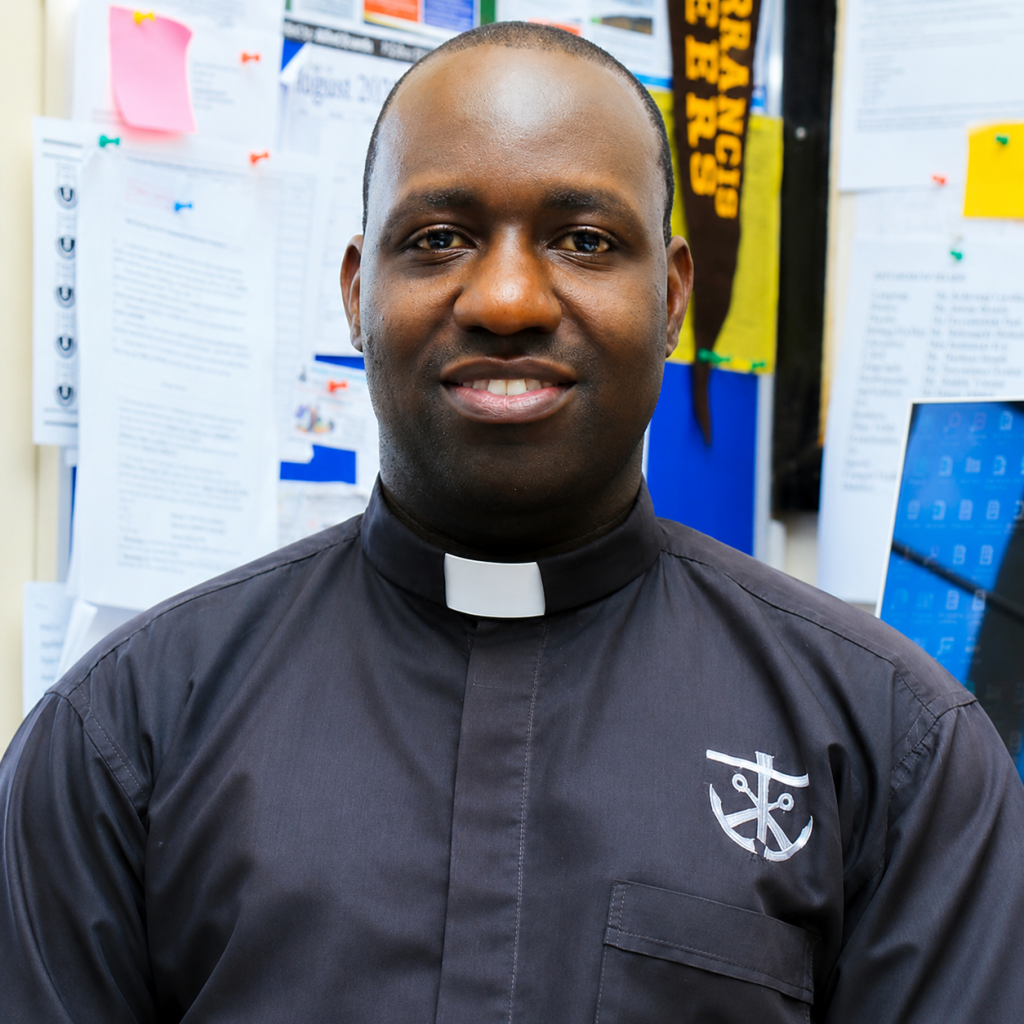
I am Fr. Henry Kajubi Ssenteza, a religious priest of the Congregation of Holy Cross, where I have served for the past fifteen years, including nine years in the priesthood. I hail from Kasana-Luweero Diocese and belong to Nakaseke Parish. Currently, I serve at Holy Cross Lake View Secondary School in the Diocese of Jinja as the Deputy Headteacher in charge of Discipline and Management. In addition, I teach Mathematics and Physics
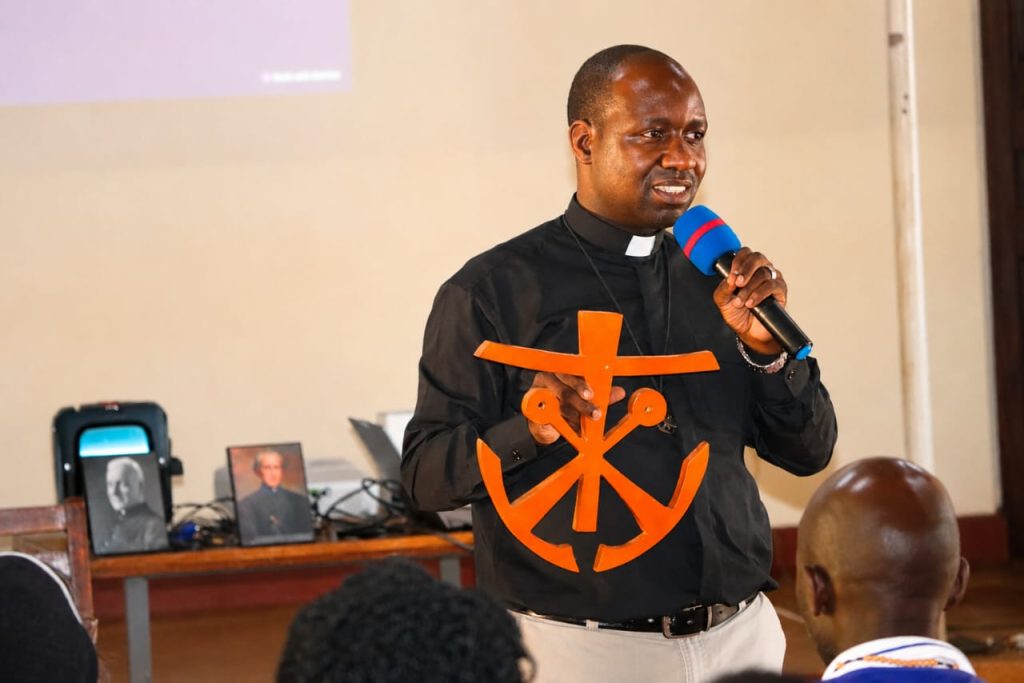
Besides my ministry at Lake View, I am a PhD candidate in Nuclear Physics at Makerere University, specializing in Spectroscopy and Environmental Radioactivity. I am deeply in love with both faith and science. If you look for me at Makerere University, you will most likely find me in the Physics Department; if you cross over to the University of Nairobi, you will find me immersed in the laboratory at the Institute of Nuclear Science and Technology, conducting my research experiments. I see my life’s work as bridging the gap between the altar and the lab. I look at the invisible forces of nature to see how we can become better stewards of the world God entrusted to us.
Tell us briefly about your journey to priesthood
My journey to the priesthood started with a deep wonder about both the seen and the unseen. Even as a young boy in primary three, I admired Monsignor Lawrence Mbwega at Lweza Parish and felt a strong pull toward the life of a priest. When I shared this admiration with him, he gave me a simple, practical starting point: ‘Go and start serving as an altar boy.’
As I grew older, that curiosity naturally expanded into the sciences. By the time I reached high school, I found myself praying a very specific prayer, asking God for the grace to love Physics, Chemistry, Biology, and Mathematics, and to offer them at A-level. He answered that prayer beautifully, granting me a government scholarship to study a Bachelor of Science with Education, majoring in Mathematics and Physics, at Makerere University. After graduating, I joined the Congregation of Holy Cross in 2008 and was ordained a priest in 2017.
What inspired you to pursue a scientific field that many people may not associate with religious life?
Our ministry, like Jesus’ own, is fundamentally about giving life. I have always believed that faith starts with a faithful response to the laws of nature, where a profound divine revelation is already hidden. When we understand nature better, we grow to grasp the unseen.
Think about the Gospel, where Jesus spat on the ground, made mud, and smeared it to heal a blind man’s eyes (cf. John 9:6). How is that possible? As a physicist, I see the Creator interacting directly with fundamental atomic matter, reorganizing it by His divine authority. In Nuclear Physics, quantum mechanics explores this exact frontier, studying the tiniest, unseen subatomic particles and revealing the incredible, hidden mysteries of God embedded in creation. Looking into this quantum world has simply made me fall deeper in love with the Creator. Pursuing Nuclear Physics is just an extension of this Love. It is not a distraction from my vocation; it helps me see the grace holding the invisible fabric of creation together.
How do you see the relationship between faith and science, especially for those who may see the two as being in conflict?
Though the relationship between faith and science presents profound questions that demand careful reflection, I have always found that they ultimately converge because they both seek the truth. Faith gives me the meaning and purpose of life, while science explains the mechanisms of how God’s creation operates. They do not fight; they fulfill each other.
I have a deep appreciation for the wisdom and genius of St. Pope John Paul II in his encyclical Fides et Ratio. He beautifully reminded us that faith and reason are the two wings on which the human spirit rises to contemplate the truth. The same God who reveals Himself through Scripture is the God whose fingerprints are visible in the order and beauty of creation. Science is a language of God. Now, why shouldn’t we love it? The more deeply I study nature, the more I am led to wonder at the Creator who sustains it.
As a priest, my goal is to bring souls closer to God and give hope to the suffering. As a Nuclear Physicist, studying environmental radioactivity helps me protect public health and safeguard our water, air, soil, etc. Both callings flow from the same source of divine charity. Science is simply a beautiful gift to live out our Christian vocation of service and stewardship. I encourage you my fellow priests and religious not to fear the sciences, but to embrace them as valuable pathways for serving humanity and deepening our appreciation of the Creator.
Are there aspects of Catholic teaching that particularly inspire your environmental research?
Absolutely. At its core, my research is driven by a fundamental Catholic truth: creation is a sacred gift from God, and we have a serious moral obligation to be its responsible stewards. Our work in the sciences is a vital way we cooperate with the Creator to unfold His creation, elevate human culture, and serve the human family (cf. Gaudium et Spes, 57).
Looking back, I see a beautiful providential design in my academic path. During my Master’s research, I focused on studying radionuclides in food. Now, for my Ph.D., I am investigating radionuclides and other potentially cancer-causing agents in water. There is something deeply sacramental about this journey. After all, food nourishes life, and water sustains it. By examining their safety, I am actively defending human health and safeguarding vulnerable communities.
As both a religious priest and a physicist, I cannot look at this as mere data collection or cold academic research. For me, it is a direct extension of my priesthood, a tangible form of preaching and service. The altar is where I celebrate the mysteries of faith; the laboratory is where I explore the mysteries of creation. Both are places of service, drawing me closer to God while helping me serve His people. Together, they remind me that knowledge must be guided by love and placed at the service of humanity. Science gives me the tools to understand the physical world, but it is my faith that gives meaning to that knowledge, directing it toward the common good and inspiring me to care for both human dignity and our common home.
How does your work contribute to environmental protection?
In a very practical way, my research acts as a line of defense for both creation and human life. I focus on assessing radionuclides and other toxic, cancer-causing contaminants that sneak into our food supply and water sources. Since we are, quite literally, what we eat and drink, safeguarding these essential resources is one of the most direct ways we can protect the human person.
By gathering hard scientific evidence on how these contaminants spread through agricultural practices, industrial pollution, mining, and poor waste disposal, I am able to provide the data needed to make informed, life-saving decisions. It is about creating policies that stop the degradation before it reaches our people.
As both a priest and a physicist, I do not see this as a detached corporate environmental project. I see it as a concrete service to the common good. It is a practical, modern expression of what it truly means to exercise responsible stewardship over the world God has entrusted to us.
What misconceptions do people commonly have about nuclear physics?
Without a doubt, the biggest misconception is that nuclear physics is strictly about atomic bombs and weapons of mass destruction. When people find out I am a priest specializing in this field, their immediate reaction is almost always: ‘So, Father, are you building bombs?’
It is a completely natural reaction because the word ‘nuclear’ is so heavily associated with war, radiation disasters, and fear. But that is only a tiny, distorted piece of the picture. The truth is that every single human being, every living organism, and the entire universe has a nuclear dimension. Matter itself is made up of atoms and atomic nuclei. God has placed one of the greatest energies in creation within the smallest of things, the atomic nucleus, and within the largest of bodies, the stars themselves. The same nuclear energy that powers our Sun and sustains life on Earth is a profound reminder of the wisdom, beauty, and power woven into creation. Yet, like many of God’s gifts, how we choose to use it can mean the difference between life and death, healing and destruction, stewardship and exploitation.
My research is miles away from weaponry. I focus entirely on food, water safety, and identifying potential cancer-causing contaminants in the environment. Here in Uganda, and across the globe, peaceful nuclear techniques are used every single day to improve agricultural yields, assess water quality, monitor environmental pollution, and save lives through cancer diagnostics and targeted radiotherapy. Far from creating tools for destruction, my work uses the hidden forces of physics to protect human life, promote environmental stewardship, and serve the common good
If you could leave our readers with one key message about faith, science, and caring for our common home, what would it be?
It is beautifully simple: love nature and love God. We must always remember that the very same God who reveals Himself to us through faith has also given us the gift of reason to understand the world around us. These two gifts are meant to walk hand in hand.
By bringing the light of faith into the laboratory and the precision of science into our care for the environment, we do more than just solve technical problems. We actively help build a healthier, more just, and more hopeful world for our people today, and for the generations yet to come. May it be done so that in all things God may be glorified (cf. 1 Pet 4:11), for He is all in all (cf. 1 Cor 15:28).”