
By Fr. Paul Nsubuga
Artificial intelligence (AI) is advancing rapidly and has attracted significant interest from both private enterprises and governmental bodies. The primary focus has been on its technological breakthroughs and potential applications. Although concerns about its rapid development and associated ethical challenges have been raised, these issues are often overshadowed by widespread enthusiasm. Consequently, AI is often portrayed as an ideal technology capable of addressing all of humanity’s challenges.
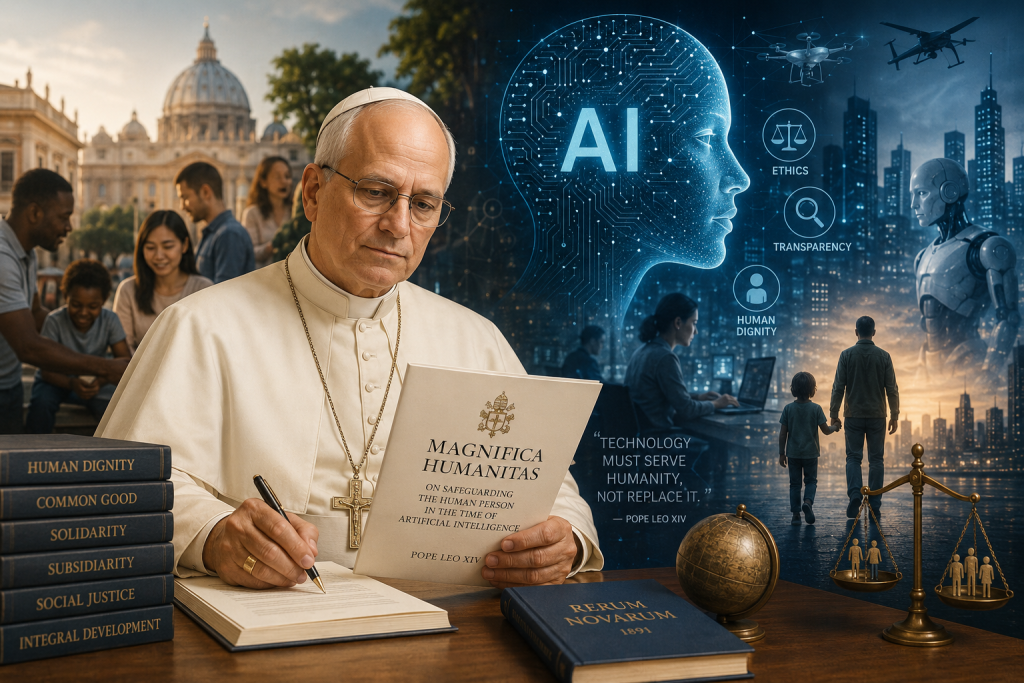
In his encyclical “Magnifica Humanitas (translated as magnificent humanity): On Safeguarding the Human Person in the Time of Artificial Intelligence,” formally released on May 25, 2026, Pope Leo XIV, calls for a pause in the unregulated expansion of this technology. He argues that the pursuit of AI’s success is often prioritised over the dignity of those involved in its development. The Pope calls for restraint in the advancement of AI.
While some may find it unexpected that his first major document addresses Artificial Intelligence, this focus aligns with his stated intention to follow the example of Pope Leo XIII. Pope Leo XIII defended human dignity during the Industrial Revolution through his encyclical Rerum Novarum, issued on May 15, 1891. In that document, Pope Leo XIII examined the effects of industrialisation on workers, families, and the essence of humanity – highlighting how individuals were reduced to mere components of a production system. He also addressed the responsibilities between labour and capital, as well as the relationship between government and citizens, during a period when efficiency was often valued above human welfare.
Pope Leo XIV identifies AI as the defining revolution of the contemporary era. Drawing a parallel to Pope Leo XIII’s response to the Industrial Revolution, Cardinal Robert Francis Prevost adopted the name Leo XIV to emphasise the challenges posed by AI. In his encyclical, Pope Leo XIV articulates the Church’s responsibility to address technological developments. He maintains that the Church’s mission is to disseminate the Gospel and Christ’s message of salvation. According to John 10:10, Jesus says he came so that humanity might have life in abundance. While this fullness is ultimately realised in heaven, it also pertains to earthly existence. Jesus seeks to deliver humanity not only from sin but also from the suffering and oppression resulting from sin. Consequently, the Church is concerned with both spiritual salvation and the quality of life in the present. This commitment includes acts of charity and advocacy against injustice or actions that undermine human dignity, as every individual is created in God’s image. In 1Jn 4:20, the apostle reminds us that we cannot pretend to love God, whom we do not see, and hate our neighbour, whom we see. St. Paul also reminds us in Rm 13:8 that love is the only debt we owe to each other. By addressing threats to human dignity, the Church continues Christ’s mission to promote a full and meaningful life.
The Church’s principles of protecting human dignity, promoting the common good, solidarity, subsidiarity, social justice, and integral development are collectively referred to as Catholic Social Teaching. In contemporary society, nearly every aspect of life is influenced by AI, which has the potential to marginalise individuals and prioritise technology over human relationships. Preserving authentic human connections remains essential. Pope Leo XIV examines the relevance of each component of Catholic Social Teaching to AI and explores strategies for its responsible application. AI systems, which depend on large language models and extensive data sets, risk reducing individuals to mere statistics or economic units. Digital resources, particularly information and data, constitute a common good and should not be monopolised by a select few. Pope Leo XIV acknowledges that, despite the significant advancements enabled by AI, the technology can also facilitate manipulation, control, surveillance, and the formation of monopolies.
With the increasing adoption of AI tools across various sectors, particularly in education, Pope Leo XIV cautions that there is a risk of producing a generation deficient in critical thinking skills. While he acknowledges AI’s potential to enhance creativity, he also highlights its role in generating fake news, deep fakes, and other forms of harmful content that require urgent attention. Additionally, there is growing concern regarding the deployment of AI in warfare through autonomous weapons, which he asserts should be unequivocally condemned and prohibited.
A comprehensive understanding of Pope Leo XIV’s encyclical Magnifica Humanitas requires recognising that he does not oppose Artificial Intelligence per se. Rather, he advocates inclusive, transparent dialogue among all AI stakeholders. Developers should engage with end users; policymakers should collaborate with funders of AI research and development; and experts from disciplines such as sociology, psychology, and anthropology should assess AI’s societal impacts. Broad participation is essential, as the future of AI cannot be determined solely by engineers and programmers, given its profound personal and social implications. For this reason, open dialogue is imperative. Pope Leo XIV acknowledges the positive contributions of technology and AI, yet cautions against allowing their benefits to overshadow potential risks.
The Holy See also addresses issues that many global leaders have hesitated to confront. He asserts that if the exponential growth of AI remains unchecked and continues to supplant human roles across all domains, humanity risks losing its essential identity in favour of technological progress. The encyclical thus serves as a significant reflection on the human condition in the era of AI and is relevant to both Christian and non-Christian audiences, as it emphasises the preservation and promotion of human dignity. By articulating these concerns, Pope Leo XIV provides a thoughtful analysis of what it means to be human in the age of AI, offering valuable insights for all individuals as AI increasingly influences society.
